
Some people love mathematics, while others prefer reading. It’s a never-ending debate where math and reading are set as complete opposites. In fact, many have have fallen into the belief that reading is more important. After all, it can be said that literacy skills provide the foundation for all other learning, including math. However, it can easily be proven that math is just as essential to a well-rounded education as reading.
Math can be defined as the study of numbers, shapes, quantities, space, and patterns. Studying mathematics and reading help with different areas of development and brain processing. Reading relies on language processing and decoding in order to communicate, while math deals more with logical reasoning and problem-solving. Although very different subjects, they work together to provide knowledge and skills that are both critical for daily life and communication.
Reading is sequential and linguistic, while math is more conceptual, spatial, and pattern-based. For many children, math is more intuitive and relies on logic, problem-solving, and conceptual understanding. However, depending on how your child learns and how their brain works, they may favor one subject over the other. Nevertheless, it’s important to see both subjects as complementary and equally important. Summer reading is often prioritized, with schools offering summer reading lists and competitions, but it is important to practice math too.
Here are some tips to highlight math skills this summer and make learning math more fun.
Teach Math Fluency
Fluency is most often associated with reading, but math fluency is an important skill as well. To be proficient at math, kids should be as comfortable with their numbers as they are with their letters. Young children can practice writing and identifying numbers, while older kids can work at becoming fluent in addition and subtraction and then later on multiplication and division facts. Early math fluency sets kids up for success by making it easier and faster to do more complex algebraic equations in the future.
Flashcards, daily practice, and repetition are great tools for building fluency. In addition, the ChildWatch eServices and Parent Portal allow parents to see daily activities and events to further learning at home by practicing the concepts taught at childcare.
Find Math in Everyday Life
Learning is always easier when it is relevant and has intrinsic value. Find ways to show kids that mathematics plays a large role in everyday life. Math concepts and lessons can be found in daily tasks and errands like cooking, driving, and shopping. If you look, there are endless opportunities for hands-on math learning experiences. For example, kids can practice measuring ingredients, identifying numbers on street signs and licence plates, counting money, and looking for shapes in their environments.
Combine Literacy and Mathematics
For kids who are more “math reluctant” and prefer reading, there are children’s books that can help encourage a love for math. These types of books encourage counting and allow kids to explore different mathemmatic concepts like shapes, patterns, and sizes. Many of these books are picture books for younger kids, but there are magazines and other resources for older kids as well. Additionally, word problems are a great way to practice problem solving skills and build reading comprehension. Word problems can be found online and some kids may enjoy writing their own word problems as well.
Play with Math
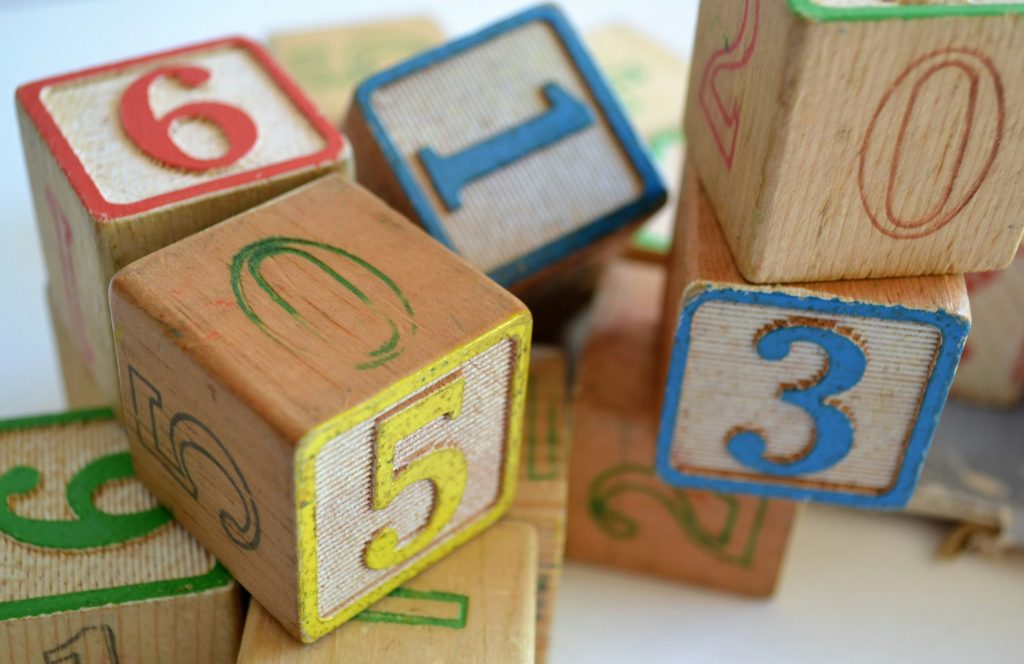
The truth of the matter is that math is all around us. Some kids will say they don’t like math because it’s boring, but it’s very easy to make math fun. Math can be so much more than repetivie worksheets and drilling flashcards. In fact, many games and toys provide the perfect opportunity to sneak some math into your child’s daily activities. Legos and building blocks are great tools for teaching size, shapes, and spatial relationships. Additionally, board games with dice, like Chutes and Ladders, provide a fun way to practice counting, and basic addition and subtraction.
Reading is often the highlighted subject in schools, but math skills are also essential. Math proficiency helps develop critical thinking, problem-solving, and logic that helps children succeed in their school careers. In addition to developing these cognitive skills, mathematics is a part of our daily lives and an important skill for everyone to practice and develop.